Well, while I'm in the
picture-less world that I currently live in, I figure I can write something cooking-related that does not
require pictures. Specifically, I'd like to provide a few guidelines I've observed and employed when marinating meat (you marinate something, the something you marinate with is a marinade). I've been meaning to do something along these lines for a while, so I figure why not now?
What is a marinade? A marinade is basically a flavor-inducing liquid, that can also tenderize or alter the texture (e.g., by
caramelizing) of the final product. They can be used for grilling (my preferred application), baking, braising, stewing, steaming (in the case of fish) frying, or virtually any food preparation technique. However, certain marinades lend themselves to some preparations more than others. For example, a sugary marinade that is likely to
caramelize when heated might be better suited for the grill or oven than for a pan-fry preparation (at least for thicker cuts of meat that would need to be fried for more than a few minutes).
What's in a marinade? Well, it depends, really. Marinades almost always have some sort of an acid, but the other ingredients can vary widely. Below are some of the more common elements I've noticed in marinades.
Acid: Adds flavor and helps with tenderizing the meat. Examples include citrus juice, vinegars, or alcohol (typically wine). Depending on the style of food, different acids might be appropriate. For example, with for stir-fry or other Asian-inspired marinades, I often use rice wine vinegar or lemon juice (note - a stir-fry sauce can sometimes be a marinade recipe with corn starch added for thickening (added at the end of cooking)). For
Mexican dishes, I often use lime juice. For
Italian, I often use balsamic vinegar (go lightly - it packs a
lot of flavor) or lemon juice. If you're planning to
de glace a meat dish using wine (e.g., when making
stew), using some of the wine in the marinade is a good choice.
Fat: Perhaps not as essential as an acid, fats can still be very important in a marinade. This is because some flavors (see below) are not water
soluble, and instead need to be carried into the meat by a fat (e.g.,
capsaisin - the spicy ingredient in hot peppers). I typically use either a neutral oil that can withstand high heat (many vegetable/grain oils qualify) or an oil that can itself impart some flavor (e.g., olive oil). The choice depends on the specific type of food (e.g., you probably wouldn't use olive oil for a stir-fry) as well as the cooking method (if you're going with a high-heat cooking method, it may be best to use an oil that can tolerate high heats).
Flavor: When it comes down to it, a marinade is often defined by the flavorings that are added. Sometimes I use combinations of herbs and spices that are tried and true (e.g.,
herbes de provence) and sometimes I get creative. Herbs and spices are the most obvious
flavorings, but others are important to keep in mind. For example, the vinegars and fats can bring a lot of flavor, as can things like garlic and ginger or other liquids you bring into the marinade (e.g., soy or
Worcestershire sauce). If you are using a
pre-mixed herb/spice combination (e.g., jerk seasoning,
herbes de provence), be sure to get one that doesn't contain salt. Salt certainly helps to enhance flavors, but you can add that yourself. There's no sense paying a lot of money for a flavoring that contains salt when salt is available so cheaply on its own.
Sugars: Sugars can help enhance both flavor and texture. Sugars generally
caramelize at high temperatures, which can be a good or a bad thing, depending on your goals. If you're afraid of burning the sugars, you can marinate the meat in a sugar-less marinade, and
withold some of the marinade. Then, add the sugar of your choice, and brush it on the meat toward the end of cooking. Think BBQ sauce (which typically contains a sugar, such as molasses or brown sugar) - quite often it is best added towards the end of grilling to get a nice
carmalized BBQ flavor, without charring on the grill.
Putting it all together: Make your marinade in a blender or food processor to fully integrate (i.e., emulsify)
hydrophillic (water
soluble) and hydrophobic (fat-
soluble) ingredients and to chop up ingredients like garlic, ginger, green onions, hot peppers, and so forth. Marinate your meat in a plastic bag in the refrigerator (placed into another bowl to catch any leaks) for at least 30-minutes before cooking.
Remember that different combinations of these ingredients can result in wildly different flavors. I've used lemon, lime, and orange juices for Asian and Italian dishes alike, but different "flavors" and fats can distinguish the dishes. Feel free to be creative in combining flavors. For example, I made a stir-fry the other day that used rice wine vinegar, soy sauce, curry powder, cayenne pepper, and corn starch for the sauce that was very good. Adding cumin, garlic, and ground up
jalepeño peppers to lime juice and soy sauce creates a classic
tex-
mex flavor. Pair flavors from similar regions of the world (e.g., French wine and
herbes de provence, soy sauce, rice wine vinegar, and ginger).
Also, marinating is not just for meat. I will often marinate fruits and vegetables that I'm planning to cook on the grill (mushrooms, zucchini, asparagus, pineapple).
 The "batter" in an ice bath
 Churning away...
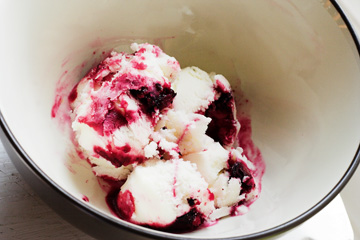 Finished product!